MiceDirect
Porcellio aff. laevis 'Milkback'
Porcellio aff. laevis 'Milkback'
Couldn't load pickup availability
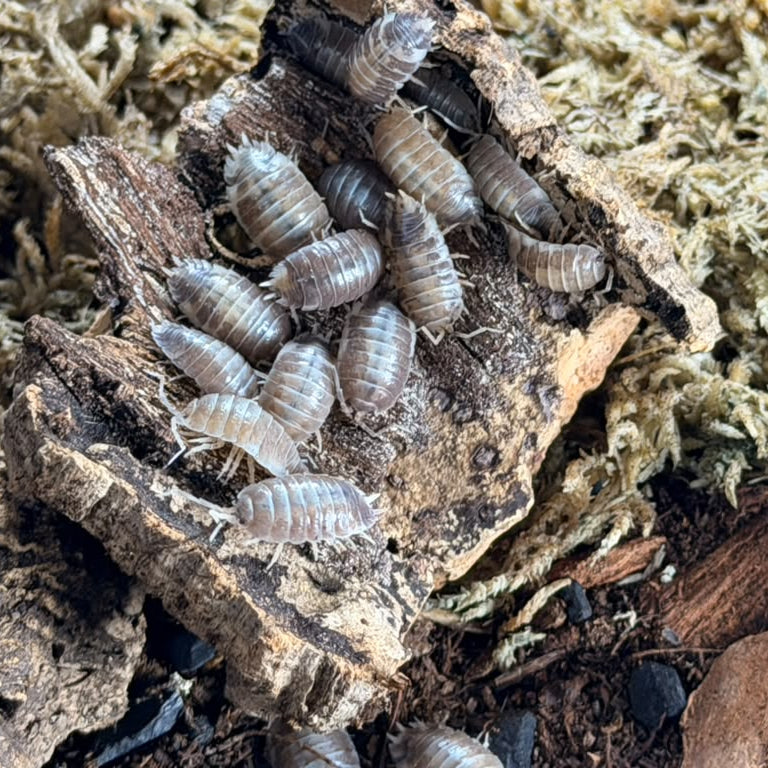
Porcellio aff. laevis ‘Milkback’ – Cream-Backed Isopods
Creation Cultivated ‘Milkback’ is a large, smooth-bodied isopod recognized for its pale cream-to-white back framed by darker gray or brown sides.
Although commonly sold as Porcellio laevis, the Milkback hobby line is more accurately treated as Porcellio aff. laevis because its exact species identity remains unresolved.
Milkbacks combine distinctive two-tone coloration with active behavior, a strong feeding response, and dependable colony growth.
Why Isopod Keepers Choose Creation Cultivated
Two-Tone Milkback Pattern — Features a pale dorsal area bordered by darker side coloration.
Large Smooth Body — Develops an impressive glossy appearance and substantial adult size.
Active Display Species — Frequently visible during feeding and colony maintenance.
Strong Colony Growth — Reproduces readily after becoming established.
Powerful Appetite — Efficiently processes leaf litter, food scraps, and animal waste.
Professionally Packed — Carefully prepared for secure live-animal transit.
Product Details
Hobby Identification: Porcellio aff. laevis ‘Milkback’
Common Trade Label: Porcellio laevis ‘Milkback’
Coloration: Cream or milky white across the back with gray-to-brown sides
Adult Size: Approximately 0.7–0.9 in. (18–23 mm)
Care Level: Beginner
Reproduction Rate: Moderate to fast once established
Behavior: Active, protein-seeking, and unable to roll into a complete ball
Natural differences in size, age, pale-back coverage, and side coloration should be expected.
Care Requirements
Temperature: Approximately 68–80°F (20–27°C)
Moisture: Maintain a consistently moist retreat with a larger moderately dry area.
Ventilation: Provide moderate to high cross-ventilation.
Substrate: Use a deep organic substrate containing decomposing hardwood and abundant leaf litter.
Diet: Provide leaf litter, vegetables, and frequent supplemental protein.
Calcium: Keep cuttlebone, limestone, oyster shell, or another calcium source continuously available.
Commonly Used For
Milkback isopods are commonly kept as display animals, breeding colonies, occasional feeders, and cleanup crews in larger enclosures with robust inhabitants.
Because they are large and strongly protein-seeking, they are not recommended with very small, delicate, freshly molted, or soft-bodied animals.
Our Commitment
Your satisfaction matters. If there is an issue with your order, contact us and our team will work to resolve it promptly and professionally.
Distinctive live isopods. Carefully raised. Professionally packed. Delivered directly to your door.
Disclaimer: Live animals. Not for human consumption. Never release isopods into the wild.
Share